
KAMMAK Journal / Glassware care
A wine glass needs room for more than its outline. The route into a cupboard, the clearance above its rim and the space between neighboring bowls all affect how easily you can put it away and take it out.
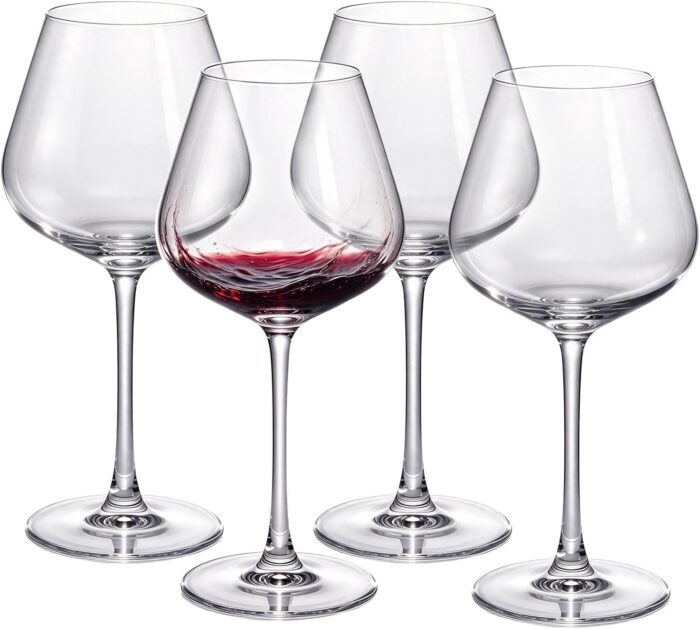
Upright, upside down or hanging: what changes?
The important distinction is where the glass rests. Upright storage places it on its foot or base. Inverting it onto a shelf places the rim against that surface. A suitable hanging rack instead supports the foot while the bowl hangs below.
| Position | Practical use | Check first |
|---|---|---|
| Upright | A straightforward cupboard arrangement for stemmed or stemless glasses. | Shelf height, widest diameter and room to lift each glass. |
| Upside down on a shelf | Covers the opening, but makes the rim a contact point. | Do not assume a delicate wine glass is designed for this position. |
| Hanging by the foot | Uses space beneath a shelf for compatible stemware. | Foot support, stem clearance, bowl spacing, installation and removal path. |
On a narrow screen, scroll within the table to see every column.
ZWIESEL GLAS’s handling guidance recommends upright storage, a dry location with a consistent temperature, spacing between glasses and no stacking. This supports an upright starting point; check the instructions for your own glass before choosing another arrangement.
Finish drying before long-term storage
Draining after washing and storing until the next dinner are separate tasks. Follow the care directions for the exact glass, then check that the bowl, foot and shelf are dry before closing the cupboard. A damp towel under the rim should not become its permanent storage surface.
RIEDEL’s glass-care instructions warn against drying glasses upside down on a metal rack because the rim can be damaged. They also advise against holding the foot while twisting the bowl during polishing. These are useful handling cautions, not evidence that another brand shares RIEDEL’s dishwasher suitability.
For the KAMMAK flute example below, the listed care instruction is hand wash only. Support the part you are drying rather than using the stem to resist a twisting motion. Let the glass dry fully before returning it to its assigned space.
Measure the cupboard and the way your hand enters it
Measure usable space with doors open and any shelf liner already in place. The cabinet’s advertised dimensions can include panels, trim and hardware that reduce the opening available to a glass.
- Find the lowest overhead obstruction. Measure from the shelf surface to the shelf above, including any projecting hinge, light or support.
- Measure the glass’s total height. Stand it upright and measure from the bottom of its foot to the rim. A stem measurement alone is not enough.
- Check the widest part. Compare bowl width and foot diameter. The larger dimension matters when placing neighboring glasses.
- Allow a removal path. You need to grip and lift the glass without its rim contacting the shelf above or its bowl knocking the next glass.
- Try the full arrangement. Once dimensions look suitable, place one empty glass first, then add the others with gaps. Do not slide a full row together until the bowls touch.
There is no single spare-height figure that proves every cupboard works. Your grip, the cabinet opening and the glass shape change the space needed. If height is consistently tight, compare a shorter model using our stemmed versus stemless wine glass guide; stemless does not automatically mean narrow or stackable.
A tall-stemware example: calculate the space above the rim
This tall-stemware example is from the KAMMAK collection. Its listed dimensions show how to start a cupboard-clearance calculation. We have not physically tested this design in your cupboard or on a hanging rack.
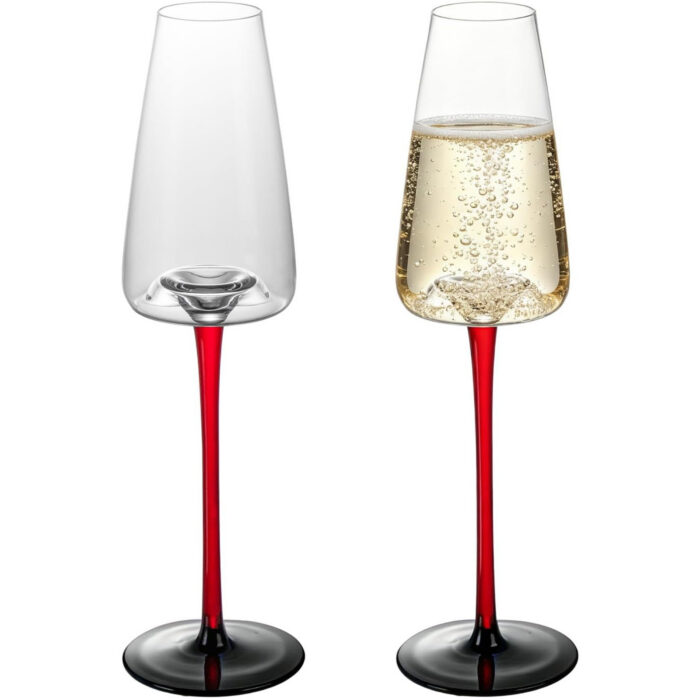
The red option in the Colored-Stem Champagne Flutes set lists a height of 10.24 inches. For an illustrative cupboard with 12 inches of usable height, the subtraction is 12 − 10.24 = 1.76 inches above the rim. That is remaining space, not a recommended minimum or a guarantee that your hand can lift the glass out.
The same red option lists a 2.95-inch foot diameter. Two feet placed edge to edge would span 5.90 inches, but that is not a usable storage-width recommendation: you still need separation, room at the sides and the widest bowl measurement. A foot diameter also says nothing about whether its thickness fits a rack channel.
From the KAMMAK collection
KAMMAK Colored-Stem Champagne Flutes, Set of 2 — Red
The red option provides a listed height for checking overhead cupboard clearance; confirm the remaining rack dimensions separately.
- Red option: 10.24 inches high
- Listed foot diameter: 2.95 inches
- Set of two; hand wash only
Check five points before using a hanging rack
“Fits wine glasses” is not a complete compatibility specification. Check the rack maker’s dimensional limits, mounting requirements and load rating, along with the glassmaker’s guidance. A normal stemware rack cannot support a stemless glass in the same way.
- Entry opening: the foot must enter through the designed opening without force. Measure its diameter and thickness, including a raised edge.
- Supporting rails: the foot must rest securely on both sides. An opening wide enough to admit the foot is different from the narrower channel that supports it.
- Stem channel: check the stem diameter and any curve or decorative feature along the sliding path. Nothing should need to bend or squeeze through.
- Bowl clearance: measure the widest bowl and compare it with adjacent rows and glasses along the same rail. A rack’s advertised glass count can vary with bowl size.
- Space below and in front: include the rack’s drop beneath the shelf, the hanging glass and the room needed to slide it out. Check door movement and nearby objects too.
If the rack’s published information omits a necessary measurement, ask its maker before buying. The flute example here has no verified rack-fit test or published complete foot-and-stem profile. A photo and nominal capacity cannot fill those gaps. Use upright storage while compatibility is unresolved.
Arrange the shelf around the glasses you reach for
Put frequently used glasses where you can remove one without reaching through a crowded row. Keep occasional-use sets together farther back only when each can still be retrieved without moving several fragile neighbors. Avoid storing loose accessories above the glasses where they could fall into a bowl.
Choose a clean shelf away from strong-smelling products; RIEDEL specifically cautions against storing glasses beside strong odors. Check the rim under good light when bringing a glass out. If you find a chip or crack, set that glass aside rather than returning it to the rotation.
For a new purchase, keep a short note with your usable shelf height, maximum width per position, number of glasses and any verified rack dimensions. Use that note while browsing the KAMMAK wine glass collection, and request missing measurements before committing to a set that must fit a particular space.