.kmk-blog.lux-article{ –txt:#111827; –muted:#6b7280; –bg:#f5f5fb; –card:#ffffff; –accent:#b91c1c; –edge:#e5e7eb; –radius:20px; –shadow:0 18px 45px rgba(15,23,42,.12); font-family:system-ui, -apple-system, BlinkMacSystemFont, “Segoe UI”, Roboto, “Helvetica Neue”, Arial, sans-serif; color:var(–txt); line-height:1.85; font-size:16px; } .kmk-blog .wrap{max-width:900px;margin:0 auto;padding:32px 16px 40px;} /* Hero */ .kmk-blog .hero{ background:radial-gradient(circle at top left,#fee2e2 0,#f9fafb 45%,#e0e7ff 100%); border-radius:28px; padding:32px 28px; box-shadow:var(–shadow); border:1px solid rgba(255,255,255,.9); position:relative; overflow:hidden; } .kmk-blog .hero:before{ content:””; position:absolute; inset:auto -40px -80px auto; width:220px; height:220px; background:radial-gradient(circle,#f59e0b 0,transparent 60%); opacity:.16; } .kmk-blog .eyebrow{ font-size:13px; text-transform:uppercase; letter-spacing:.12em; color:var(–accent); font-weight:650; margin-bottom:10px; } .kmk-blog h1{ margin:0 0 10px; font-size:clamp(28px,3.6vw,36px); font-family:”Playfair Display”, Georgia, serif; font-weight:650; line-height:1.18; } .kmk-blog .lede{ color:var(–muted); font-size:17px; line-height:1.95; max-width:780px; } .kmk-blog .meta{ display:flex; flex-wrap:wrap; gap:8px; margin-top:16px; font-size:12px; color:var(–muted); } .kmk-blog .pill{ display:inline-flex; align-items:center; gap:6px; padding:4px 10px; border-radius:999px; background:rgba(255,255,255,.92); border:1px solid rgba(209,213,219,.7); } .kmk-blog .pill-dot{width:6px;height:6px;border-radius:999px;background:var(–accent);} /* Article */ .kmk-blog article{ margin-top:28px; background:var(–card); border-radius:24px; padding:26px 22px 32px; border:1px solid var(–edge); box-shadow:0 10px 30px rgba(15,23,42,.06); } .kmk-blog h2{margin:28px 0 10px;font-size:24px;font-weight:700;} .kmk-blog h3{margin:18px 0 6px;font-size:18px;font-weight:650;} .kmk-blog p{margin:10px 0 14px;font-size:16px;} .kmk-blog ul{padding-left:20px;margin:6px 0 14px;font-size:16px;} .kmk-blog li{margin-bottom:8px;} .kmk-blog strong{font-weight:700;} .kmk-blog a{color:#b91c1c;text-decoration:none;font-weight:600;} .kmk-blog a:hover{text-decoration:underline;} /* Dividers */ .kmk-blog .divider{ margin:22px 0; height:1px; background:linear-gradient(to right,transparent,#e5e7eb,transparent); border:0; } /* Callouts */ .kmk-blog .quote-box{ margin:16px 0; padding:14px 16px; border-radius:16px; border-left:4px solid var(–accent); background:#fef3f2; font-size:16px; color:#7c2d12; font-style:italic; } .kmk-blog .tip-box{ margin:18px 0; padding:14px 16px; border-radius:14px; background:#f9fafb; border:1px solid #e5e7eb; font-size:15px; line-height:1.75; } .kmk-blog .tip-label{ font-size:12px; text-transform:uppercase; letter-spacing:.14em; color:#b91c1c; font-weight:700; margin-bottom:4px; } /* Soft CTA card (low presence) */ .kmk-blog .soft-cta{ margin:16px 0; padding:14px 14px 16px; border-radius:16px; border:1px solid #e5e7eb; background:linear-gradient(180deg,#ffffff,#f9fafb); } .kmk-blog .soft-cta .cta-title{ font-size:13px; text-transform:uppercase; letter-spacing:.14em; color:#7c2d12; font-weight:750; margin:0 0 6px; } .kmk-blog .soft-cta p{margin:8px 0 0;font-size:15px;color:#374151;} .kmk-blog .soft-cta a{color:#b91c1c;font-weight:700;} /* Mini grid */ .kmk-blog .mini-grid{display:grid;gap:10px;margin:10px 0 16px;} @media(min-width:720px){.kmk-blog .mini-grid{grid-template-columns:repeat(2,minmax(0,1fr));}} .kmk-blog .mini{ border:1px solid #e5e7eb; border-radius:14px; padding:12px 12px 10px; background:#f9fafb; } .kmk-blog .mini b{display:block;margin-bottom:4px;} .kmk-blog .mini span{color:#4b5563;font-size:14px;line-height:1.65;} /* FAQ */ .kmk-blog .faq{margin-top:12px;border-top:1px dashed #e5e7eb;padding-top:14px;} .kmk-blog .faq-item{border:1px solid #e5e7eb;background:#fff;border-radius:14px;padding:12px 12px 10px;margin:10px 0;} .kmk-blog .faq-q{font-weight:750;margin:0 0 6px;font-size:16px;} .kmk-blog .faq-a{margin:0;color:#374151;font-size:15px;line-height:1.75;} @media (max-width:640px){.kmk-blog .hero{padding:22px 18px;}.kmk-blog article{padding:20px 16px;}}
Shot Glass vs Whiskey Glass · Home Bar Guide

Shot Glass vs Whiskey Glass: Two Different Rituals (and Why It Matters)

They both hold spirits. But they don’t create the same experience. A shot glass is built for precision and energy—measured pours, quick toasts, consistent serving. A whiskey glass is built for space and pace—aroma, texture, and slow sipping. Here’s how to choose the right glass for the moment.

Editorial + practical Size, feel, and use cases Reading time · 5–7 min

In a home bar, glassware quietly sets the rules. It decides whether a pour feels measured or generous, whether a toast feels quick or lingering. If you’ve ever hosted friends and noticed that “everyone poured differently,” you’ve already met the difference between these two glasses.

Choose by purpose

For capacity and serving differences, review the complete shot-glass guide. If you’re building a slow-sip setup, browse K9 whiskey glasses.


First Difference: Size (and What It’s Designed to Do)

A shot glass is a compact serving vessel. In the U.S., 1.5 oz is a common reference for a single pour, but physical glass capacities and house measures vary. Use a marked jigger when exact measurement matters.

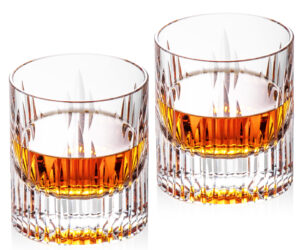
A whiskey glass (rocks / old fashioned style) is designed around sipping. It typically holds far more liquid than any shot— not because you pour more spirit, but because the ritual often includes space for ice, aroma, and a comfortable grip.

Shot glass Built for measured pours and consistent serving. Best for shots, cocktail building, and quick toasts.
Whiskey glass Built for aroma and pace. Best for neat pours, ice, and slow sipping moments.
The real difference isn’t “small vs big.” It’s precision vs pace.

Second Difference: Shape & Feel

Shot glasses tend to be narrower and cleaner in silhouette—so the volume reads clearly and pours stay controlled. A polished rim and stable base change the serving experience more than most people expect.

Whiskey glasses tend to be wider with a heavier base. That weight anchors the hand, and the open surface area helps aromas open up—especially when sipping neat spirits or serving with ice.

Practical note
Using a whiskey glass to “eyeball” a shot often leads to over-pouring. If you care about consistency (especially while hosting), a dedicated shot glass keeps the table calibrated.

Choose Based on the Moment

Here’s the simplest way to decide—based on the tempo you want:

Choose a shot glass when you want:

  • Consistency: everyone gets the same pour
  • Control: measured cocktails and accurate servings
  • Energy: toasts, celebrations, and quick rituals

Choose a whiskey glass when you want:

  • Time: a slower sip and longer finish
  • Aroma: space for the spirit to open up
  • Ice flexibility: cubes, spheres, or a simple chill

Hosting Tip: The “Even-Pour” Rule

In a group setting, the glass you choose becomes the standard without anyone saying it. Shot glasses make that standard visible—especially if guests are mixing drinks themselves.

Meanwhile, a whiskey setup is less about measurement and more about mood: a heavier base, a calmer pace, and a glass that feels composed on the table.

A simple home bar upgrade

Start with a marked measure and review shot-glass sizes and larger whiskey-glass alternatives. Then add a slow-sip ritual for quiet nights: K9 whiskey glasses for slow sipping.

Summary

  • Shot glass: measured pours, precision, consistent serving
  • Whiskey glass: aroma, ice flexibility, slow sipping
  • Best choice: depends on the tempo of the moment

In a well-considered bar, both have a place. One marks a moment. The other extends it.

Frequently Asked Questions

Is a shot glass the same as a whiskey glass?

No. A shot glass is designed for measured pours (commonly 1.5 oz in the U.S.), while a whiskey glass is designed for sipping and typically offers more space for aroma and ice.

Can I use a whiskey glass for shots?

You can, but it’s not ideal for accurate measurement. Eyeballing a shot in a larger glass often leads to over-pouring. A dedicated shot glass keeps serving consistent—especially when hosting.

What is the standard shot size in the U.S.?

A standard U.S. shot is commonly 1.5 ounces. Some shot glasses are larger (2–2.5 oz) for added flexibility and hosting use cases.

Frequently Asked Questions

Is a shot glass the same as a whiskey glass?

No. A shot glass is designed for measured pours (commonly 1.5 oz in the U.S.), while a whiskey glass is designed for sipping and typically offers more space for aroma and ice.

Can I use a whiskey glass for shots?

You can, but it’s not ideal for accurate measurement. Eyeballing a shot in a larger glass often leads to over-pouring. A dedicated shot glass keeps serving consistent—especially when hosting.

What is the standard shot size in the U.S.?

A standard U.S. shot is commonly 1.5 ounces, though some bars pour 2 ounces. Using a measured shot glass ensures consistent serving.

Can you drink whiskey in a shot glass?

You can, but it changes the experience. A shot glass is built for quick pours, while whiskey is typically better enjoyed in a wider glass that allows aroma to open up.

How many ounces is a typical whiskey pour?

A typical whiskey pour in the U.S. is about 1.5 to 2 ounces. The glass may hold more volume because it’s designed for aroma and ice, not measurement.

Is a double shot the same as two shots?

In most bars, a double shot equals twice a standard shot—commonly around 3 ounces total. Exact measurements vary by region.

How many ounces is a double shot?

In the U.S., a double shot is typically about 3 ounces (2 × 1.5 oz). Some establishments may pour slightly more depending on house standards.

Do I need both shot glasses and whiskey glasses at home?

If you host often, having both adds versatility. A marked jigger supports consistent cocktail measurement, while whiskey glasses are suited to slow sipping. Review shot-glass sizes and current alternatives or browse K9 whiskey glasses to build a balanced setup.

Sources and editorial notes

These sources support the specific general statements noted above; they do not certify the material, process, care, or performance of an individual KAMMAK product.

Leave a Reply